Lill Tschudi
1911–2004Lill Tschudi (1911–2004) was a Swiss printmaker and one of the most accomplished artists associated with the Grosvenor School. Best known for her colour linocuts of modern life, she captured the speed, movement and energy of the interwar years through sharply simplified forms, strong diagonals and bold combinations of colour.
Born in Schwanden, in the Swiss canton of Glarus, Tschudi became interested in colour linocutting after seeing prints by the Austrian artist Norbertine Bresslern-Roth. In 1929 she moved to London to study at the Grosvenor School of Modern Art, where she worked under Claude Flight, the leading advocate of the colour linocut in Britain.
Flight encouraged his students to treat the linocut as a modern medium suited to the imagery of contemporary life. Tschudi responded with subjects including jazz musicians, motor racing, the London Underground, sporting events and men working on electricity pylons. Prints such as Jazz Band, Fixing the Wires and Sticking up Posters combine the influence of Futurism and Vorticism with a highly individual sense of rhythm and design.
Tschudi’s association with The Redfern Gallery began while she was still a student. Her work was included in British Linocuts at Redfern in 1930, followed by British Lino-Cuts 1931, Modern Colour Prints in 1932 and Colour Prints and Contemporary Oils in 1933. These exhibitions formed part of the important series initiated at Redfern by Claude Flight after the gallery’s landmark First Exhibition of British Lino-Cuts in 1929.
In 1931 Tschudi left London for Paris, where she studied with André Lhote, Gino Severini and Fernand Léger. These encounters broadened her understanding of Cubism, Futurism and geometric abstraction, but Flight remained an important artistic mentor and correspondent. Tschudi continued to send work to him from Switzerland, maintaining a close connection with the British printmaking world.
Her print Fixing the Wires was reproduced by Flight in his 1934 book The Art and Craft of Lino Cutting and Printing, and is characteristic of her ability to transform an everyday modern subject into a dynamic arrangement of line and colour. The Victoria and Albert Museum and the British Museum both acquired impressions of the print during the 1930s.
Tschudi returned permanently to Switzerland in 1935, settling again in Schwanden. Although geographically removed from London, she continued to produce linocuts for many years and ultimately created more than 350 prints. From the mid-1940s her work also moved increasingly towards abstraction.
For much of her career Tschudi received greater recognition in Britain than in Switzerland, but this changed in later life. In 1986 she was awarded the Swiss National Print Prize, acknowledging her contribution to twentieth-century printmaking.
Her international reputation has grown considerably since her death in 2004. In 2008–10 her work was included in British Prints from the Machine Age: Rhythms of Modern Life, 1914–1939, shown at the Museum of Fine Arts, Boston, the Metropolitan Museum of Art, New York, and the Wolfsonian in Miami.
Tschudi’s work is held in major public collections including the British Museum, Victoria and Albert Museum, Metropolitan Museum of Art, New York, Bibliothèque nationale de France and National Gallery of Australia.
The Redfern Gallery has continued to show Tschudi’s work alongside that of Claude Flight, Sybil Andrews, Cyril Edward Power and other artists of the Grosvenor School, renewing a connection that began with the gallery’s pioneering linocut exhibitions of the early 1930s.
Works
-
 Lill TschudiBells, 1937Linocut25 x 28 cmSigned in pencil in image lower right. Numbered 14/50 in pencil lower left. Titled in English and German in pencil lower right margin%3Cdiv%20class%3D%22artist%22%3E%3Cspan%20class%3D%22artist%22%3E%3Cstrong%3ELill%20Tschudi%3C/strong%3E%3C/span%3E%3C/div%3E%0D%3Cdiv%20class%3D%22title%22%3E%3Cem%3EBells%3C/em%3E%2C%201937%3C/div%3E%0D%3Cdiv%20class%3D%22signed_and_dated%22%3ESigned%20in%20pencil%20in%20image%20lower%20right.%20%20Numbered%2014/50%20in%20pencil%20lower%20left.%20%20Titled%20in%20English%20and%20German%20in%20pencil%20lower%20right%20margin%3C/div%3E%0D%3Cdiv%20class%3D%22medium%22%3ELinocut%3C/div%3E%0D%3Cdiv%20class%3D%22dimensions%22%3E25%20x%2028%20cm%3C/div%3E
-
 Lill TschudiNudes, 1933Linocut on thin off-white oriental laid paper26 x 28 cmNumbered 15 from the edition of 50 impressionsSigned, numbered, and titled%3Cdiv%20class%3D%22artist%22%3E%3Cspan%20class%3D%22artist%22%3E%3Cstrong%3ELill%20Tschudi%3C/strong%3E%3C/span%3E%3C/div%3E%0D%3Cdiv%20class%3D%22title%22%3E%3Cem%3ENudes%3C/em%3E%2C%201933%3C/div%3E%0D%3Cdiv%20class%3D%22signed_and_dated%22%3ESigned%2C%20numbered%2C%20and%20titled%3C/div%3E%0D%3Cdiv%20class%3D%22medium%22%3ELinocut%20on%20thin%20off-white%20oriental%20laid%20paper%3C/div%3E%0D%3Cdiv%20class%3D%22dimensions%22%3E26%20x%2028%20cm%3C/div%3E%0D%3Cdiv%20class%3D%22edition_details%22%3ENumbered%2015%20from%20the%20edition%20of%2050%20impressions%3C/div%3E
-
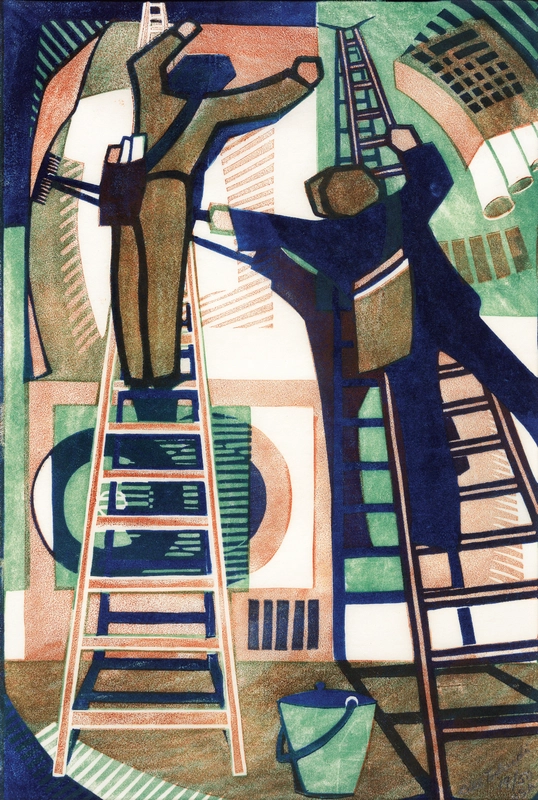 Lill TschudiSticking up Posters, 1933Linocut on thin oriental laid paper30.2 x 20 cmFrom the edition of 50 impressionsSigned and numbered in image lower right%3Cdiv%20class%3D%22artist%22%3E%3Cspan%20class%3D%22artist%22%3E%3Cstrong%3ELill%20Tschudi%3C/strong%3E%3C/span%3E%3C/div%3E%0D%3Cdiv%20class%3D%22title%22%3E%3Cem%3ESticking%20up%20Posters%3C/em%3E%2C%201933%3C/div%3E%0D%3Cdiv%20class%3D%22signed_and_dated%22%3ESigned%20and%20numbered%20in%20image%20lower%20right%20%3C/div%3E%0D%3Cdiv%20class%3D%22medium%22%3ELinocut%20on%20thin%20oriental%20laid%20paper%3C/div%3E%0D%3Cdiv%20class%3D%22dimensions%22%3E30.2%20x%2020%20cm%3C/div%3E%0D%3Cdiv%20class%3D%22edition_details%22%3EFrom%20the%20edition%20of%2050%20impressions%3C/div%3E
-
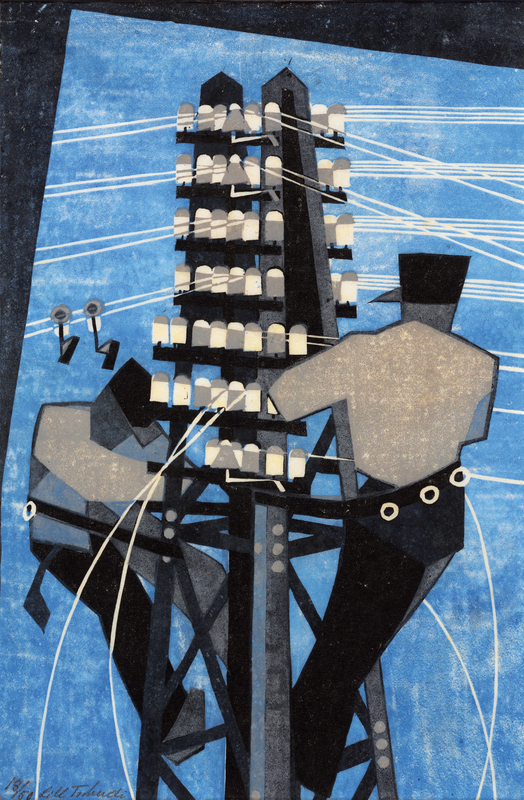 Lill TschudiFixing the Wires, 1932Linocut on oriental paper30.2 x 20.2 cmFrom the edition of 50 impressionsNumbered and signed in image lower left; titled in margin%3Cdiv%20class%3D%22artist%22%3E%3Cspan%20class%3D%22artist%22%3E%3Cstrong%3ELill%20Tschudi%3C/strong%3E%3C/span%3E%3C/div%3E%0D%3Cdiv%20class%3D%22title%22%3E%3Cem%3EFixing%20the%20Wires%3C/em%3E%2C%201932%3C/div%3E%0D%3Cdiv%20class%3D%22signed_and_dated%22%3ENumbered%20and%20signed%20in%20image%20lower%20left%3B%20titled%20in%20margin%3C/div%3E%0D%3Cdiv%20class%3D%22medium%22%3ELinocut%20on%20oriental%20paper%3C/div%3E%0D%3Cdiv%20class%3D%22dimensions%22%3E30.2%20x%2020.2%20cm%3C/div%3E%0D%3Cdiv%20class%3D%22edition_details%22%3EFrom%20the%20edition%20of%2050%20impressions%3C/div%3E
Related content
-
 Publications
The Redfern Gallery
Modern and Contemporary Prints - Part Two Mar 15, 2023A fully illustrated catalogue published to coincide with 'Modern and Contemporary Prints - Part Two',...Read more -
 Publications
Modern British Art
Spring Exhibition Mar 14, 2023A fully illustrated catalogue to coincide with the exhibition 'Modern British Art: Spring Exhibition' held...Read more
-
 Exhibitions
IFPDA Fine Art Print Fair 2021
Online Booth 15 Oct - 3 Nov 2021IFPDA FINE ART PRINT FAIR 2021 The Redfern Gallery was founded in September 1923 on...Read more -
 News
The Redfern at the IFPDA Print Fair, New York
Oct 22, 2019The Redfern Gallery will be exhibiting once again at the 2019 edition of the IFPDA...Read more
-
 News
The Redfern at Olympia
Jun 17, 2019The Redfern Gallery will be showing once again at this year’s Olympia Art & Antiques...Read more -
 News
IFPDA Fine Art Print Fair 2017
Oct 28, 2017The Redfern will be exhibiting at the IFPDA Fine Art Print Fair in New York...Read more
-
 Exhibitions
Modern British Art
Spring Exhibition 8 Mar - 6 Jun 2017A selection of Modern British worksRead more -
 Exhibitions
Summer Exhibition
Modern Master Prints & Contemporary Prints & Works on Paper 19 Jul - 3 Sep 2016“As one might expect from the Redfern Gallery, there is a most up-to-date display of...Read more
