Jean Spencer
1942–1998Jean Spencer (1942–1998) was a British abstract painter and relief-maker and a founding member of the Systems Group. Her work developed from rigorously constructed monochrome reliefs based on mathematical sequences to increasingly complex investigations of colour, while remaining rooted throughout in ideas of order, variation and visual balance.
Born in Frimley, Surrey, Spencer studied at Bath Academy of Art from 1960 to 1963. Among her tutors was Malcolm Hughes, whose systematic approach to abstraction had a profound influence on her development. Hughes used mathematical principles to determine the relationships between geometric forms, and Spencer soon began exploring similar possibilities in her own shallow white reliefs. The two subsequently formed a lifelong artistic and personal partnership.
Her reliefs were first exhibited at the AIA Gallery in 1964, alongside work by Kenneth Robinson and Michael Tyzack, and her first solo exhibition followed at Bear Lane Gallery, Oxford, in 1965. Rather than composing intuitively, Spencer devised numerical systems from which a series of possible arrangements could be generated. Identical squares might be shifted, overlapped or reordered, producing variations within a predetermined structure.
In 1969 Spencer joined Malcolm Hughes, Jeffrey Steele and David Saunders in founding the Systems Group, becoming its youngest member. Influenced by artists including Kenneth and Mary Martin and by the architectural and mathematical ideas of Max Bill, the group sought an art based on clarity, economy and systematic organisation. Spencer nevertheless resisted the idea that the system eliminated individual judgement: for her it provided a framework within which numerous visual possibilities could be discovered.
The Systems Group exhibited internationally, beginning with an exhibition in Helsinki in 1969. Its most important British presentation was the Arts Council touring exhibition Systems, curated by Stephen Bann and first shown at the Whitechapel Art Gallery in 1972. Spencer’s involvement placed her at the centre of an important strand of British Constructivist art that developed alongside, but independently of, the more dominant movements of the period.
During the mid-1970s Spencer increasingly turned her attention from geometric complexity towards colour. As she later put it, “chromatic complexity supersedes geometrical complexity.” She studied the colour theories of artists including J.M.W. Turner, Kazimir Malevich, Piet Mondrian and Richard Paul Lohse, while carrying out extensive experiments with pigments, hue, saturation and luminosity. Geometry remained important, but increasingly served as a framework for exploring relationships between colours.
These later paintings combine meticulous preparation with a surprisingly sensuous response to colour. Spencer sought arrangements in which no single hue dominated another, allowing neighbouring colours to alter and intensify one another. Nicholas Serota described her paintings as occupying a boundary between reason and emotion, order and expression.
Her international connections also developed. In 1977 Spencer joined Arbeitskreis, the European collective devoted to systematic and Constructivist art. During the 1980s she became closely involved with Exhibiting Space, an interdisciplinary project bringing together artists, architects, musicians and theorists, and in 1990 she founded Countervail, a group for women working within the Constructivist tradition. Its members included Natalie Dower, Judith Dean and Susan Tebby.
Spencer also taught throughout much of her career and from 1988 worked at the Slade School of Fine Art, where she was later appointed Reader in Fine Art. She married Malcolm Hughes in 1997. Both died within the following year, and in 2000 Tate organised a memorial exhibition devoted to their work. Six paintings from Spencer’s final series entered the Tate collection.
In 2014 The Redfern Gallery presented Jean Spencer 1942–1998: Paintings, Reliefs and Works on Paper, bringing together work from different periods of her career, from the early geometric constructions to the colour-based paintings of her later years.
Spencer’s work represents an important contribution to post-war British Constructivism. Beneath its apparent precision and restraint lies a persistent interest in variation, visual tension and the expressive possibilities that can emerge from working within a system.
Works
-
 Jean SpencerUntitled (Red/Black/Blue/Green), 1990Pastel on paper27 x 38 cm%3Cdiv%20class%3D%22artist%22%3E%3Cspan%20class%3D%22artist%22%3E%3Cstrong%3EJean%20Spencer%3C/strong%3E%3C/span%3E%3C/div%3E%0D%3Cdiv%20class%3D%22title%22%3E%3Cem%3EUntitled%20%28Red/Black/Blue/Green%29%3C/em%3E%2C%201990%3C/div%3E%0D%3Cdiv%20class%3D%22medium%22%3EPastel%20on%20paper%3C/div%3E%0D%3Cdiv%20class%3D%22dimensions%22%3E27%20x%2038%20cm%3C/div%3E
-
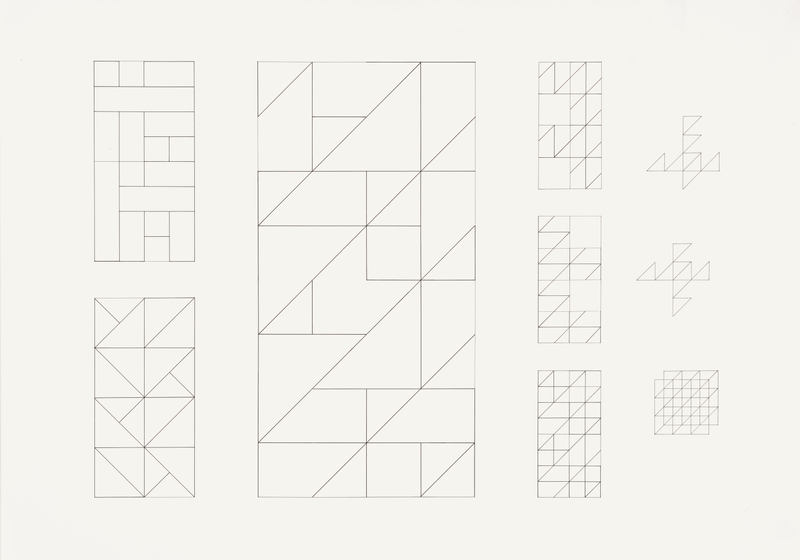 Jean SpencerPreparatory Study for Systems Grouping, 1975Pen, ink, and gouache on paper88 x 62.5 cm%3Cdiv%20class%3D%22artist%22%3E%3Cspan%20class%3D%22artist%22%3E%3Cstrong%3EJean%20Spencer%3C/strong%3E%3C/span%3E%3C/div%3E%0D%3Cdiv%20class%3D%22title%22%3E%3Cem%3EPreparatory%20Study%20for%20Systems%20Grouping%3C/em%3E%2C%201975%3C/div%3E%0D%3Cdiv%20class%3D%22medium%22%3EPen%2C%20ink%2C%20and%20gouache%20on%20paper%3C/div%3E%0D%3Cdiv%20class%3D%22dimensions%22%3E88%20x%2062.5%20cm%3C/div%3E
Related content
-
 Publications
Modern British Art
Spring Exhibition Mar 14, 2023A fully illustrated catalogue to coincide with the exhibition 'Modern British Art: Spring Exhibition' held...Read more -
 Exhibitions
Spring Exhibition
Modern British Art 13 Mar - 31 May 2019This spring exhibition of Modern British art includes paintings and sculpture by Eileen Agar, Francis...Read more


