Henry Moore OM, CH
1898–1986Henry Moore OM, CH (1898–1986) was one of the most important sculptors of the twentieth century and the first British sculptor to achieve truly international fame during his lifetime. Best known for his monumental reclining figures, mother-and-child groups and pierced abstract forms, he transformed modern sculpture through a lifelong exploration of the human body, landscape and natural form.
Born in Castleford, Yorkshire, Moore initially trained as a teacher before serving in the First World War. In 1919 he entered Leeds School of Art on an ex-serviceman’s grant and later studied at the Royal College of Art in London. There he developed an increasingly independent approach to sculpture, rejecting academic modelling in favour of direct carving and drawing inspiration from ancient, non-European and modern art.
The Redfern Gallery played an important role at the very beginning of Moore’s career. In 1924, while still a student at the Royal College of Art, he took part in his first group exhibition at The Redfern Gallery, alongside fellow students including Barbara Hepworth, Edward Burra, Percy Horton, Roland Vivian Pitchforth and Charles Tunnicliffe. Redfern was the first commercial gallery to show the carvings of both Moore and Hepworth, several years before Moore’s first solo exhibition at the Warren Gallery in 1928.
During the late 1920s and 1930s Moore developed the themes that would remain central throughout his career. The reclining figure became particularly important, allowing him to explore the relationship between human form and landscape. Increasingly he opened up the solid mass of sculpture through holes and internal spaces, treating emptiness as an active part of the work.
Moore was also closely connected with the development of Surrealism and modernism in Britain. In 1936 he served on the organising committee of the International Surrealist Exhibition at the New Burlington Galleries in London, exhibiting both sculpture and drawings.
During the Second World War his celebrated drawings of people sheltering in the London Underground brought his work to a much wider public. After the war he returned to sculpture on an increasingly monumental scale. In 1948 he won the International Prize for Sculpture at the Venice Biennale, and his international reputation expanded rapidly through exhibitions and public commissions.
Major commissions followed for institutions and public spaces around the world, including Reclining Figure for the UNESCO headquarters in Paris. Moore’s sculpture increasingly moved from direct carving towards bronze, allowing him to enlarge small maquettes into monumental works while retaining the organic forms and tactile surfaces of his earlier sculpture.
His international standing was confirmed by major exhibitions at the Museum of Modern Art, New York, in 1946, Tate in 1968 and the Forte di Belvedere, Florence, in 1972. By the later twentieth century his monumental sculptures had become familiar presences in museums, civic spaces and landscapes throughout the world.
In 1977 Moore and his family established the Henry Moore Foundation, dedicated to encouraging public appreciation of sculpture and preserving his artistic legacy. He continued to work until his death at Perry Green, Hertfordshire, in 1986.
The Redfern Gallery has continued to acknowledge its early association with Moore, including his work in exhibitions devoted to the gallery’s history and to Modern British art. His appearance at Redfern in 1924 remains one of the most significant episodes in the gallery’s earliest history, marking the emergence of an artist who would go on to transform the international standing of British sculpture.
Works
-
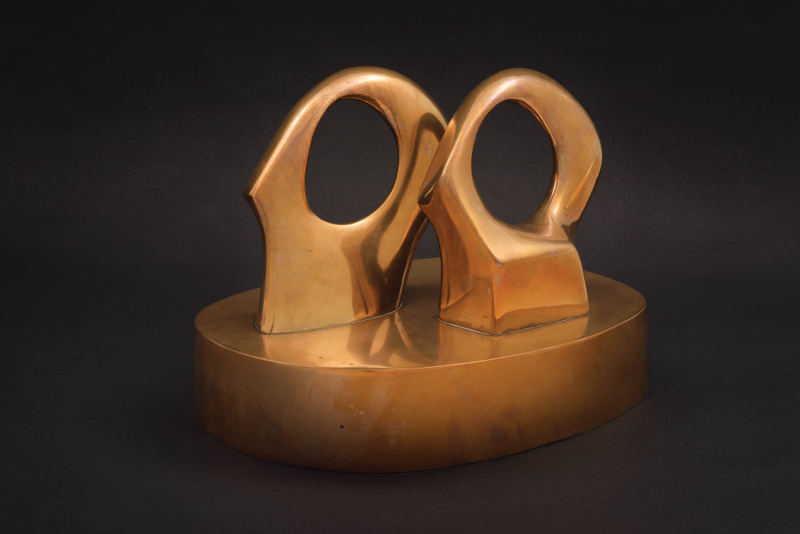 Henry Moore OM, CHMaquette for Double Oval, 1966Bronze20 x 27 x 21 cmFrom the edition of 9 castsSigned%3Cdiv%20class%3D%22artist%22%3E%3Cspan%20class%3D%22artist%22%3E%3Cstrong%3EHenry%20Moore%20OM%2C%20CH%3C/strong%3E%3C/span%3E%3C/div%3E%0D%3Cdiv%20class%3D%22title%22%3E%3Cem%3EMaquette%20for%20Double%20Oval%3C/em%3E%2C%201966%3C/div%3E%0D%3Cdiv%20class%3D%22signed_and_dated%22%3ESigned%3C/div%3E%0D%3Cdiv%20class%3D%22medium%22%3EBronze%3C/div%3E%0D%3Cdiv%20class%3D%22dimensions%22%3E20%20x%2027%20x%2021%20cm%3C/div%3E%0D%3Cdiv%20class%3D%22edition_details%22%3EFrom%20the%20edition%20of%209%20casts%3C/div%3E
Related content
-
 Publications
The Redfern Gallery
Modern and Contemporary Prints - Part Two Mar 15, 2023A fully illustrated catalogue published to coincide with 'Modern and Contemporary Prints - Part Two',...Read more -
 Publications
Spring Exhibition 1989
20th Century British Paintings, Watercolours, Drawings and Ceramics Mar 15, 2023An original, fully illustrated catalogue to coincide with The Redfern Gallery's 'Spring Exhibition 1989', held...Read more
-
 Publications
Surrealism in Britain
Mar 15, 2023Published to coincide with a major Surrealism exhibition at Tate Modern, 20 September - 16...Read more -
 Publications
Modern British Art
Spring Exhibition Mar 14, 2023A fully illustrated catalogue to coincide with the exhibition 'Modern British Art: Spring Exhibition' held...Read more
-
 Exhibitions
Masterpiece 2022
Stand 303 30 Jun - 6 Jul 2022The Redfern Gallery are pleased to present a collection of Modern British Art and beyond...Read more -
 News
On this day in December...
Important events from The Redfern Gallery archives Dec 1, 2021The latest entry as part of a new, regular feature providing a summary of important...Read more
-
 News
The Redfern at Masterpiece London
Jun 24, 2019The Redfern Gallery will be showing again at Masterpiece London, where a number of works...Read more -
 Exhibitions
Spring Exhibition
Modern British Art 13 Mar - 31 May 2019This spring exhibition of Modern British art includes paintings and sculpture by Eileen Agar, Francis...Read more
